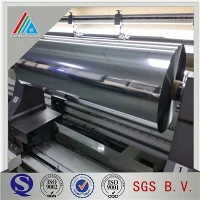
Hey there! As a supplier of Metalised BOPET Film, I've had my fair share of questions about how this amazing material adheres to different surfaces. So, I thought I'd take a deep dive into this topic and share some insights with you.
First off, let's talk about what Metalised BOPET Film is. BOPET stands for Biaxially Oriented Polyethylene Terephthalate. It's a type of polyester film that's been stretched in both the machine and transverse directions, giving it excellent mechanical properties like high tensile strength and dimensional stability. Metallizing this film involves depositing a thin layer of metal, usually aluminum, onto its surface. This not only gives the film a shiny, reflective appearance but also adds properties like barrier protection against moisture, oxygen, and light.


Now, onto the main question: how does Metalised BOPET Film adhere to different surfaces? Well, it depends on a few factors.
Surface Preparation
The first step in getting good adhesion is proper surface preparation. The surface you're applying the film to needs to be clean, dry, and free of any contaminants like dust, grease, or oil. If the surface is dirty, the film won't be able to bond properly. For example, if you're applying the film to a plastic container, you might need to wipe it down with a mild solvent to remove any fingerprints or residue.
Adhesive Selection
The type of adhesive you use is crucial for adhesion. There are different types of adhesives available, each with its own properties and suitability for different surfaces. For instance, if you're adhering the film to a porous surface like paper or cardboard, a water - based adhesive might work well. These adhesives are easy to apply and dry quickly. On the other hand, for non - porous surfaces like glass or metal, a solvent - based or hot - melt adhesive might be more appropriate. Solvent - based adhesives offer strong bonding and good chemical resistance, while hot - melt adhesives provide fast bonding and high initial tack.
Temperature and Pressure
Temperature and pressure also play important roles in adhesion. When applying the film, it's important to apply the right amount of pressure to ensure good contact between the film and the surface. This can be done using a roller or a press. Additionally, the temperature can affect the adhesive's performance. Some adhesives work better at higher temperatures, while others are more effective at room temperature. For example, hot - melt adhesives need to be heated to a specific temperature to become fluid and bond properly.
Compatibility of Materials
The compatibility between the Metalised BOPET Film and the surface it's being applied to is another key factor. Different materials have different surface energies, and for good adhesion, the surface energy of the film and the substrate should be similar. If the surface energies are too different, the film may not adhere well. For example, if you try to adhere the film to a highly hydrophobic surface, you might need to use a special adhesive or treat the surface to increase its surface energy.
Let's look at some common surfaces and how Metalised BOPET Film adheres to them:
Paper and Cardboard
Paper and cardboard are porous materials, which makes them relatively easy to bond with Metalised BOPET Film. As mentioned earlier, a water - based adhesive is often a good choice. The adhesive can penetrate the pores of the paper or cardboard, creating a strong mechanical bond. This is why Metalised BOPET Film is commonly used for packaging applications, such as wrapping boxes or making labels. Check out our 19mic 23mic 36mic PET Film for great options for paper and cardboard applications.
Plastic Surfaces
Plastic surfaces can vary widely in terms of their surface properties. Some plastics, like polypropylene, have low surface energy and can be difficult to bond to. In these cases, surface treatment methods like corona treatment or plasma treatment can be used to increase the surface energy and improve adhesion. Once the surface is treated, a suitable adhesive can be used to bond the Metalised BOPET Film. Our 100% Crucible Metallized Polyester Film Yarn Grade can be a great choice for plastic applications.
Metal Surfaces
Metal surfaces are generally smooth and non - porous. Solvent - based or epoxy adhesives are often used to bond Metalised BOPET Film to metal. These adhesives can provide strong chemical bonds with the metal surface. Before applying the adhesive, the metal surface may need to be cleaned and sometimes treated with a primer to improve adhesion. Our Metallized PET Film LDPE Coating Foam Insulation is suitable for some metal - related applications.
Glass Surfaces
Glass is a smooth and hard surface. Adhesives that can form strong bonds with glass, such as silicone - based adhesives, are often used. The glass surface needs to be thoroughly cleaned to remove any dirt or grease. Applying the film with the right amount of pressure and allowing the adhesive to cure properly is essential for good adhesion.
In conclusion, getting Metalised BOPET Film to adhere to different surfaces requires careful consideration of surface preparation, adhesive selection, temperature, pressure, and material compatibility. By understanding these factors, you can ensure a strong and long - lasting bond.
If you're interested in purchasing Metalised BOPET Film for your specific application, I'd love to have a chat with you. We can discuss your requirements and find the best solution for you. Don't hesitate to reach out and start a conversation about your procurement needs.
References
- "Handbook of Adhesives and Sealants" by Eric M. Petrie
- "Polymer Science and Technology" by Donald R. Paul and Christopher B. Bucknall